




PUBLICATION LIBRARY
Explore NITRD documents and reports including Federal Plans, Implementation Roadmaps, Strategy Documents, Scientific and Technical Reports, Workshop Reports, Supplements to the President’s Budget.

PRESENTATION LIBRARY
Presentations, reports, and webinars by a broad range of presenters from academia, government, and private sectors at various NITRD IWG meetings, workshops, and public events.
FEDERAL REGISTER DOCUMENTS
Federal Register Notices, Request for Comments, and Request for Information issued by or on-behalf of the Networking and Information Technology Research and Development Program.

LEGISLATION
The NITRD Program (formerly known as High Performance Computing and Communications (HPCC) Program) was created by the High Performance Computing Act of 1991, (P.L. 102-194).
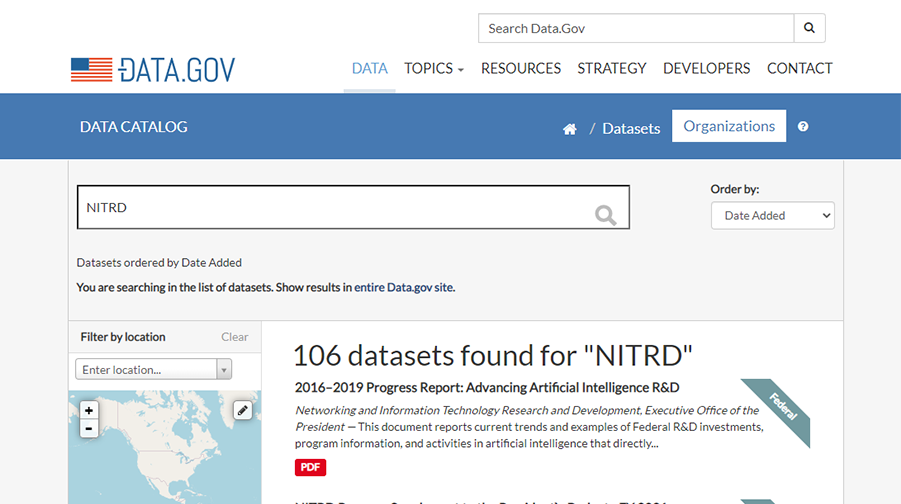
NITRD DATA CATALOG (DATA.GOV)
The home of the U.S. Government’s open data. Here you will find data, tools, and resources to conduct research, develop web and mobile applications, design data visualizations.

HISTORICAL DOCUMENTS
Historical and archival documents: FNC, HPC archives and NGI materials; Testimony by Directors of the NCO for the NITRD Program; PCAST and PITAC materials.

AI R&D INVESTMENTS
Dashboard illustrates the Federal budget for nondefense AI R&D investments across several fiscal years. It provides both an overall budget rollup, as well as breakdowns of investments by agency and by NITRD Program Component Areas (PCAs), major subject areas for Federal IT R&D.
NITRD DASHBOARD
A graphical interface for displaying NITRD budget data with drill-downs to NITRD Program Component Areas (PCAs), major subject areas for Federal IT R&D, by year and agency; illustrates Federal Agency NITRD Budget Cross Cuts as reported in the NITRD Supplement to the President’s Budget.

NITRD PROGRAM COMPONENT AREAS
The annual NITRD Program Supplement to the President’s Budget provides a technical summary of NITRD research investments and activities planned and coordinated through the NITRD Program in a given Federal budget cycle. The budget reporting and technical program summaries are organized by NITRD PCAs.

STEM PORTAL
Opportunities at Federal agencies for internships, scholarships, and other training programs targeted to all levels of experience so there is something for everyone interested in technology careers and advanced training.