

























3. High Performance Computing Research Centers (HPCRCs)
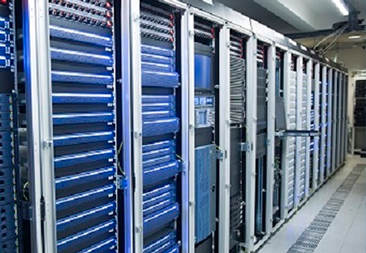
HPCRCs are a cornerstone of the HPCC Program. HPCRCs are the home of
a variety of systems: early prototypes, small versions of mature
systems, full-scale production systems, and advanced visualization
systems. The current production systems, capable of hundreds of
gigaflops of sustained throughput, will be succeeded by teraflops
systems. These systems are being used on Grand Challenge class
applications that cannot be scaled down without modifying the problem
being addressed or requiring unacceptably long execution times. The
largest of these applications are being run on multiple high
performance computers located around the country and networked in the
gigabit testbeds.
An interdisciplinary group of experts meets at these centers to
address common problems. These include staff from the HPCRCs
themselves, hardware and software vendors, Grand Challenge
applications researchers, industrial affiliates that want to develop
industry-specific software, and academic researchers interested in
advancing the frontier of high performance computing. Funding is
heavily leveraged, with HPCC agencies often contributing
discretionary funds, hardware vendors providing equipment and
personnel, and affiliate industries paying their fair share.
Industrial affiliation offers a low risk environment for exploring
and ultimately exploiting HPCC technology. Two of these industrial
affiliations are:
- The Oil Reservoir Modeling Grand Challenge in which more than 20
companies and several universities participate
- The High Performance Storage System Project in which more than 12
companies and national laboratories participate
Production-quality operating systems and software tools are developed
at these centers, thereby removing barriers to efficient hardware
use. Applications software tailored to high performance systems is
developed by early users, many of whom access these systems over the
Internet, and increasingly over the gigabit testbeds, from their
workstations. Production-quality applications software is often
first run on HPCRC hardware. The wide range of hardware at HPCRCs
makes them ideal sites for developing the conventions and standards
that enable and test interoperability, and for benchmarking systems
and applications software.
Production-quality applications software often is run first on
computing systems at HPCRCs.
The major HPCRCs are:
NSF Supercomputer Centers --
- Cornell Theory Center, Ithaca, NY
- National Center for Supercomputer Applications, Champaign-Urbana, IL
- Pittsburgh Supercomputer Center, Pittsburgh, PA
- San Diego Supercomputer Center, San Diego, CA
Tens of thousands of users from more than 800 institutions in 49 states and 111
industrial partners have computed on systems at the NSF centers. Currently there
are 8,000 users and 78 partners. The centers are developing a National Metacenter
Environment in which a user will view multiple centers as one. The National Center
for Atmospheric Research (NCAR) in Boulder, CO, also receives HPCC funds.
NSF Science and Technology Centers
- Center in Computer Graphics and Scientific Visualization -- Brown
University, Providence, RI; CalTech, Pasadena, CA; Cornell
University, Ithaca, NY; University of North Carolina, Chapel Hill,
NC; University of Utah, Salt Lake City, UT
- Center for Research on Parallel Computation, Rice University,
Houston, TX
NASA Centers --
- Ames Research Center, Mountain View, CA
- Goddard Space Flight Center, Greenbelt, MD
DOE Centers --
- Los Alamos National Laboratory, Los Alamos, NM
- National Energy Research Supercomputer Center, Lawrence Livermore National
Laboratory, Livermore, CA
- Oak Ridge National Laboratory, Oak Ridge, TN
The DOE centers accommodate more than 4,000 users from national
laboratories, industry, and academia.
Major systems at HPCRCs include one or more of each of the following
(the number of processors in the largest machine at an HPCRC is shown
in parentheses):
- Convex
- - C3880 (8 vector processors)
- Cray Research
- - C90 (16 vector processors)
- - T3D (512 processors)
- - YMP (8 vector processors)
- Digital Equipment Corp.
- - Workstation Cluster
- Hewlett-Packard
- - H-P Workstation Cluster
- IBM
- - ES9000/900 (6 vector processors)
- - PVS
- - SP1 (512 processors)
- - Workstation Cluster
- Intel
- - iPSC 860 (64 processors)
- - Paragon (512 processors)
- Kendall Square Research
- - KSR 1 (160 processors)
- MasPar
- - MasPar 2 (16,000 processors)
- - MasPar MP-1 (16,000 processors)
- nCube
- - nCUBE2
- Thinking Machines
- - CM2 (32,000 processors)
- - CM5 (1,024 processors)
Smaller versions of some of these scalable high performance systems
have been installed at more than a dozen universities. The HPCRCs
also use a variety of scientific workstations, such as those from
Silicon Graphics and Sun Microsystems, for numerous tasks.
FY 1995 Plans
- NSF will install new scalable parallel hardware and hardware
upgrades, enhance Metacenter resources, and establish several more
regional alliances.
- DOE will install two different 150 gigaflop machines at two sites.
- NASA will establish a prototype high performance computing facility
comparable in nature but not in performance to the ultimate teraflops
facility. It will be configured with advanced high performance
machines, early systems or advanced prototypes of important storage
hierarchy subsystems, and sufficient advanced visualization
facilities to enable system scaling experiments. NASA Grand
Challenge researchers in Federal laboratories, industry, and academia
will access these advanced systems using the Internet and gigabit
speed networks. These researchers will provide a spectrum of
experiments for scalability studies. Prototype systems and subsystem
interfaces and protocol standards will be established and evaluated,
accelerating the understanding of the character of future teraflops
computing systems.
- NOAA will acquire a high performance computing system for its
Geophysical Fluid Dynamics Laboratory at Princeton, NJ to develop new
scalable parallel models for improved weather forecasting and for
improved accuracy and dependability of global change models.
- EPA will acquire a scalable parallel system to support more complex
multipollution and cross-media (combined air and water) impact and
control assessments.
- Next Section
- Table of Contents
- Home Page